Nothing goes through a server
 Beam 3 min read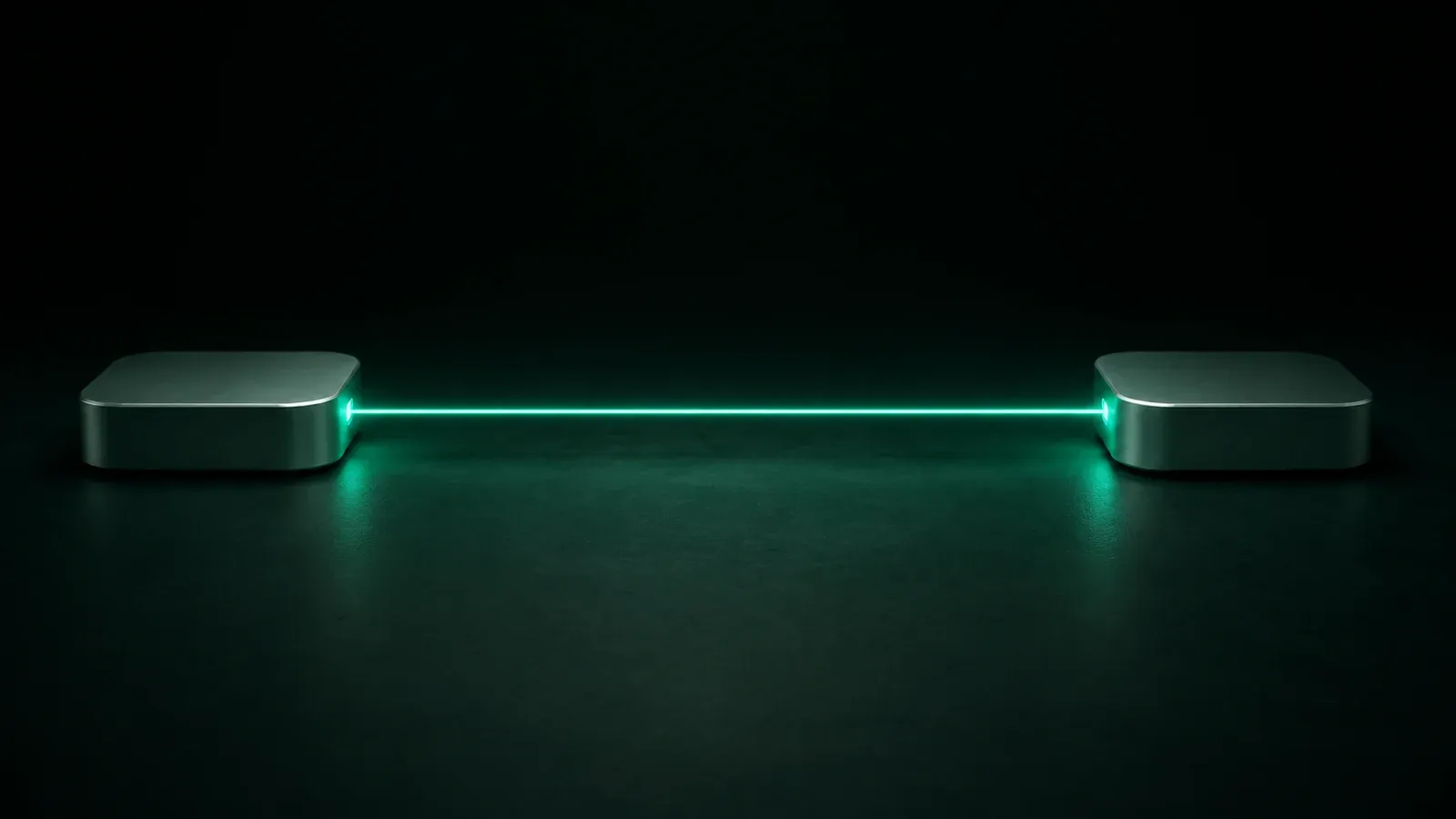
Most remote-desktop tools have a server in the middle. You sign in, the server finds your machines, and your screen travels through it on the way to you. That is convenient and it is also a third party in the path, and one more place your work exists.
Beam has no server in the middle, and no account to sign in to. When you beam a window, the picture, your keyboard and mouse input, and the clipboard if you have clipboard sync on, go straight from one of your Macs to the other. We are not in the path and cannot see any of it.
How two Macs find each other
On the same network, Beam discovers other Macs running Beam the way AirDrop finds nearby devices: locally, without asking anything outside the network. Pair them once and the connection is encrypted and pinned to those two machines.
When the Macs are apart, Beam uses your Tailscale tailnet. Tailscale gives your machines a private network that reaches across the internet, and Beam runs over it like it would over your Wi-Fi. If Tailscale is installed, Beam asks it, on the same Mac, which of your machines are on the tailnet. That question never leaves your Mac.
What leaves a Mac, and to whom
The whole list is short.
- The other Mac. The window's picture, your input, and the clipboard if sync is on. Encrypted, direct, pinned to the pair.
- beam.win. An update check, about once a day and when you ask for one, carrying the app's name and version and nothing else. Updates download from updates.beam.win.
That is everything. Beam has no analytics, no crash reporting and no telemetry. If something goes wrong and you want to tell us, the app zips its diagnostics onto your Desktop and you decide whether to attach them to an email.
Guest links
A guest link opens one of your windows in a browser, on any device, for someone who does not have Beam. It works the same way: the Mac that owns the window serves that page itself, over the same network, to whoever opens the link. Nothing is uploaded anywhere. The link is view only unless you say otherwise, and it expires after an hour.
The tradeoff
No server means no magic reachability. Two Macs that are not on the same network, and not on the same tailnet, cannot see each other, because there is nothing out there to introduce them. Setting up Tailscale is a few minutes of work, and it is work we have chosen not to do for you, because the alternative is being in the path.
We think that is the right trade for a tool that can show you another Mac's windows. What you beam is yours, it stays between your machines, and the only people who can see it are the people at either end.
More from the blog
-
Run a headless Mac mini and see its windows
Beam shares one window at a time, or a whole display when you pick one. Then make sleep and reboot reliable.
-
Use one Mac app without sharing the whole desktop
Beam puts one app window from another Mac on your desktop, with direct input, crisp text, optional audio, and no whole-desktop viewer.
-
Test Mac layouts beyond your screen
Test macOS app layouts just before and after they change, then use Beam to resize the window into shapes the other Mac can fit more easily.